Showing posts with label Guest and Public Lectures. Show all posts

Thursday, October 28, 2010

TUT Students Empowered Through Great Conversation

Katlego Legodi
TUT student, Sinenhlanhla Khumalo (centre),
brought together successful young people to empower
the youth.
TUT has held its second annual Reabua Talk Show with the topic that asked participants what or who they are in the 21st century.
The show was well attended with guest speakers; Andile Ncube from Black Face, Brothers for Life founder Mandla Ndlovu, Vivian Morodi of Johnson and Johnson and Zweli Mahlangu from the National Youth Development Fund; engaging the many youngstersin attendance on the issue.
Former Live Presenter, Andile Ncube, believes young South Africans should seize every opportunity that avails itself to them and says young people should not wait for others to do things for them.
“It’s all up to you in the end on how you make sure that you uplift yourself,” said Ncube.
As many celebrities have alcohol and drug problems, those in the audience asked Ncube how he has managed to stay clean.
“Never in my life have I tasted alcohol or smoked,” a response many were not expecting.
Ndlovu received some questions from people who say his organisation, Brothers for Life, caters for the needs of women and fails to acknowledge that both men and women can be victims of abuse. He didn’t entertain such questions and said they are just an excuse by many male abusers. He continued his usual request of men not to abuse the women in their lives.
Former student leader Vivian Morodi who is now on the marketing team at Johnson&Johnson said she used her position to uplift other students.
Television producer, Andile Ncube, feels
young people should seize opportunities.
She said there is a great need for leadership education of student political leaders so they can stop fighting with each other.
Mahlangu spoke of the work of the National Youth Development Agency in providing the youth with opportunities and advice on how they can better themselves. This, he said, is done through their youth advisory centres and mentorship programmes that happen during weekend mornings.
Organisers say this year’s show was a great success and showed definite growth from last year. It was founded by TUT student Sinenhlanhla Khumalo.

Friday, July 30, 2010

War of Words with Ndaedzo Nethonzhe

Tshepo Tshabalala

So came another exciting evening of debate organised by Cool Politics. The venue, the intimate Kaldi’s Coffee and this time around, the guest speaker was Kaya FM journalist and former TUT graduate, Ndaedzo Nethonzhe.

As always the evening began with live music from up and coming artists. This time around we were dazzled by the sounds of Edd and Adam van Veen (from Our Heritage) and Bongiziwe and the Fridge, but this time Bongiziwe was without the fridge. Nevertheless he did not disappoint but instead he put on a performance that had most people chanting for more at the end of his set.

The topic for the evening was about the future of South Africa after the World Cup. We talked about the impact the World Cup has had on the country; negative and positive, our expectations from government now that it is all over and what the World Cup has meant for our country. Ndaedzo opened the floor by asking about our experiences during the world cup. For many in the room, we concurred that we as South Africans were great hosts and we put on a spectacular show. There were many positive reports about the country, both from international and local media. Bronwyn of Cool Politics commented by saying that the World Cup showed us that our government, that has been in power since 1994, has the capacity to deliver what they have promised. They showed this by putting together a great world cup, within the deadline that was given by FIFA. One needs to ask the question, if the government could render such world class service, from infrastructure, tourism, security etc because the whole world had their eyes on them… will they be able to maintain the excellence they have displayed without the pressure from Fifa and the rest of the world? Will they remain loyal to their own people who put them in power?

We surfed on the motto ‘Alive with possibility’ by hosting a World Cup set on tight deadlines, why can’t the same government that built great stadiums, build houses and schools of the same caliber as the stadiums, to the poor people of this country. It is believed that the country received an amount of R93 billion from Fifa, of which is not the profit but has to cover the debts from constructing stadiums, roadworks and other major developments that were made from the World Cup. Ndaedzo truly believes that whatever the profit South Africa makes from Fifa, 60% of that money should be spent on education. He believes that the ‘1 Goal’ initiative that was advertised throughout the soccer spectacle will not benefit anyone. “A great PR exercise” is what he called it.

“South Africa needs to reach a point where we move to a phase where we want to be”, said Ndaedzo. We need to think and act like a developed country. A war of words erupted when the debate touched on the recent Xenophobic attacks on foreign nationals in the country. The floor seemed to be split between those who believed that the government has handled these threats exceptionally well and those who argued that our government is far too reactive. They wait for problems to spiral out of control first before they take action.

The evening came to an end with many unhappy and unsatisfied debaters. This showed that there needs to be dialogue at the very bottom to work on the challenges we face as a nation and how we can move forward. There is a need to teach the nation on how to use the media to their advantage and to become a ‘no-nonsense’ type of a society.

Friday, July 16, 2010

Mac Maharaj Says Madiba Always Fought For Human Rights & Wants Xenophobia To Stop

It was a jubilant scene in the Tshwane University of Technology’s Prestige Auditorium as people sang struggle songs with dancing during the speech by former transport minister and Robben Island inmate Mac Maharaj.

The lecture was to honour former president, Nelson Mandela, ahead of United Nations recognised International Mandela Day on Sunday. Maharaj spoke about the type of person Madiba is describing him as someone who always fights for human rights, even for hardened criminals.

He told a story of how the country’s first democratically elected president tried to stand up for another Robben Island inmate who was being assaulted by prison guards only for the prisoner to deny everything Madiba was saying. “We later found out that the man had been bought off by the guards with a packet of tobacco.”

He said all his fellow ANC members laughed at Mandela when he returned to them, but the young Madiba insisted that he would stand up for anyone who was in a similar situation.
Maharaj went on to say a lot of problems South Africa is facing at the moment are a result of poverty and the remnants of the country’s past. “Apartheid taught us not to know about Shangane people. It also said black people could get nothing with white people getting everything. Indians and coloureds were somewhere in the middle getting crumbs,” Maharaj explained.

He believes apartheid divided people and that led to a fear of the others and a suspicion among different ethnic groups. He says this fear and a suspicion of others is what has led to xenophobia as well. “They were only allowed here to be just manual labour.”

During the call to action for this year’s Mandela Day there have been various announcements asking people to learn about others in their various communities. Maharaj also made this call during his lecture.
This comes after renewed threats on foreign nationals living in South Africa. This morning the Mail And Guardian newspaper reported that the number of people crossing the border back to Zimbabwe has increased. Many of these people are fearing for their lives after several shops owned by Somalis were looted in the country.

Authorities have said these are just acts of violence and have not come as a result of xenophobia in South Africa.

President Jacob Zuma has also urged foreign nationals to go to the police should they feel their lives are threatened.

Maharaj ended by saying good deeds should not only last for 67 minutes.

Friday, May 28, 2010

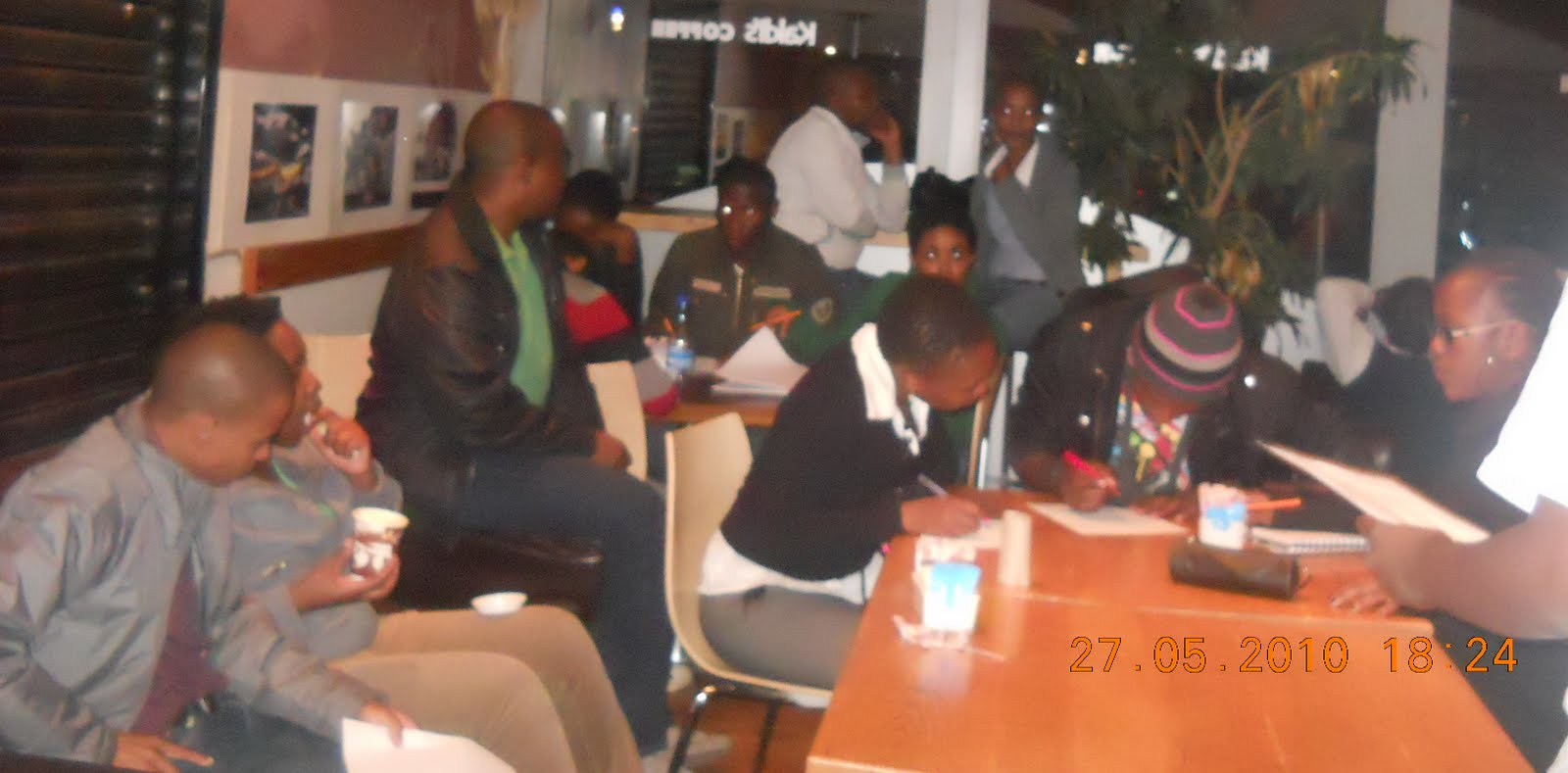
Youth Debate Media and Coolpolitics

Pearl Nicodemus

Blogging, facebooking and tweeting – that is how young people communicate these days. On Thursday night they met in Newtown, Johannesburg, to talk about how these forums can be used for the benefit of youth in the media industry.

But this was just a part of what they were discussing. The young people were split into debating teams which mainly consisted of journalism students from the Tshwane University of Technology, myself included. The debate held at Kaldi’s Coffee was organised by an organisation called Coolpolitics

Some of the topics discussed were citizen journalism, how the voice of the youth can become more prominent, how young people can challenge ideas and the state of the media in South Africa.

Their view of the largest broadcaster, the SABC, was not a very good one. The youth present felt the SABC is controlled by the government and that there is a possibility that they are not getting the full picture when it comes to the way the broadcaster imparts information. They feel that the SABC often censors information and reports favourably on government issues.

There were two sides on private media. Some felt more private companies are needed but there were those who felt that they are run by capitalists whose main purpose is to make money.

But at the end of it all everyone was in agreement that the youth has a critical role to play in the media industry. Most felt the youth just needs to tell positive stories rather than focusing on misbehaving and skankily dressed celebrities.

When it was done there was music provided by the soulful, One.

Tuesday, May 18, 2010

AWARD WINNING AUTHOR & JOURNALIST, FRED KHUMALO, A HIT WITH STUDENT JOURNOS

Pearl Nicodemus

The Student Journalism Association (SJA) organised yet another exciting guest lecturer this week.

The award winning editor of the Sunday Times’ Insight & Opinions section, Fred Vusi Khumalo, graced the aspirant journalists with his presence on 17 May 2010 at the Soshanguve Main Campus. Fred is also renowned for his rich literacy contribution to the arts. He has published numerous books such as the European Union Literary Award winning novel Bitches Brew, Seven Steps to Heaven and his riveting memoir Touch My Blood which has also been turned into a Market Theatre production.

His forthcoming book is called Life and Times of Jacob Zuma and he had to sit down for a chat with the president before writing it.

When he speaks Fred has amazing humility. He has a guy next door type of easiness which is similar to his satirical yet provocative style of writing. He made it quite clear to the students that he is not well acquainted with technology and prefers candid interaction with them.

As many of those he was talking to are under 21 and wouldn’t remember apartheid South Africa, Fred, spent a good thirty minutes explaining how working as a black reporter was in those days was. He said even being accepted into journalism school was quite a task as he had to get permission from education minister, FW de Klerk, to study at the white Technikon Natal. After getting that permission the university still refused him entry but he fought until he was accepted.

He said that experience and the political landscape of the country at the time shaped the kind of journalist he became. He said a major shock was when he arrived in Canada to work as a reporter in his twenties and found stories about cat rescues making it to the important page three. Now he had to change the stories he wrote and found that people of that country wanted light stories as well, unlike South Africa, Canada wasn’t burning.

image by wordpress                               Other salient issues that were dealt with were ethics in Journalism. Of course you cannot speak about ethics in Journalism and not mention the distressingly brilliant Kevin Carter photograph of a vulture waiting eagerly for an emaciated toddler to die before feeding on the little girl. While the photographer became a world renowned celebrity - he received tremendous criticism for taking the picture and not helping the child. The photographer’s explanation was that he had done his job and journalism comes before being a human being. This has since stirred up serious debates on media and Journalism ethics.

Fred also stressed that we as future journalists need to cover the unfolding stories of our country. He said it is our responsibility to understand the state of the nation, report on matters passionately but accurately. He also seemed excited to see a huge number of females studying journalism as it is a male dominated profession.

Then it was time for a question and answer session. These are just some of the questions asked.

Q: Is it more challenging to be a journalist now then it was during Apartheid?

Fred: Yes because political matters have become more complex. It is no longer a matter of black against white only.

Q: Are you ever criticised for your humorous approach when writing on serious issues?

Fred: You will constantly be criticised. When people stop criticising you as a journalist, you should be worried.

Students thoroughly enjoyed Fred’s visit and said the lecture was insightful and they liked the fact that he encouraged people to read and write more. There were however some who were not entirely satisfied with all his answers and especially the fact that he did not discredit journalists who left the field into other areas.

In spite of the diverse views the students have regarding the guest lecture, there is one common thread in the minds of all learners who were present - TUT always caters the Bests of the Best in the industry!!